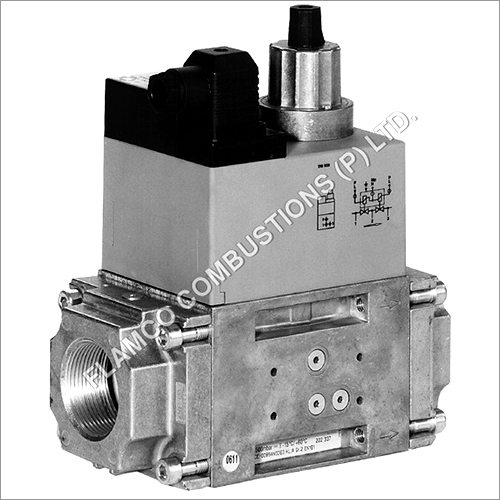
About Double Solenoid Valves
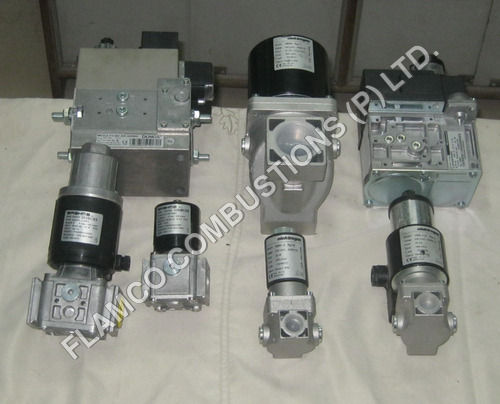
Leveraging upon our technologically-advanced production facility, we are highly engaged in exporting and supplying Double Solenoid Valves to our esteemed customers spread all across the nation. These valves are highly preferable in petrochemical, shipping yards, automobile and nuclear power plants in order to assure unobstructed flow of air and liquid. Furthermore, these Double Solenoid Valves are manufactured under the guidance of vendors' ingenious professionals using premium quality raw materials with the help of innovative technology.
Features:
Specifications:
- Max operating pressure
- 0.5 bar (50 kPa)
- Two class A valves in one housing
- DMV-D Fast opening , fast closing
- main flow rate adjustable
- DMV- DLE Slow opening , fast closing
- main flow rate adjustable
- adjustable rapid stroke for pilot gas flow
- Closed position indicator switch K01/1 add -on unit
- EC type test approval as per EC Gas appliance Directive :
- DMV-.../11... CE-0085 AN 2801
- EC type test approval as per EC Pressure EC Pressure Equipment Directive :
- DMV-.../11... CE0036
- Approvals in pother important gas consuming countries
Technical Data
| Type | Solenoid Valves |
| Material | Stainless Steel,Aluminium |
| Media | Water,Gas |
| Temperature of Media | Medium Temperature ,High Temperature |
Precision and Reliability for Automation SystemsThese double solenoid valves are engineered for exacting industrial requirements. The precision-machined aluminum alloy body, combined with a corrosion-resistant coating, ensures reliability and durability even in demanding operational environments. The NBR sealing material maintains media integrity under rigorous conditions, while rapid actuation and high-frequency handling boost productivity in automated setups.
Efficient Performance with Superior ControlEquipped with a manual override and pilot-operated piston structure, the valves offer outstanding control flexibility. Continuous duty cycles and low current draw help ensure energy efficiency throughout extended use. The IP65 protection rating safeguards the valve against dust and moisture, while the F-class coil insulation guarantees safe operation in variable ambient temperatures.
FAQs of Double Solenoid Valves:
Q: How does the manual override function benefit automated pneumatic systems?
A: The manual override enables operators to actuate the valve manually during setup, maintenance, or emergencies, ensuring system continuity and facilitating troubleshooting without disrupting the entire automation process.
Q: What type of media is suitable for use in these double solenoid valves?
A: These valves are specifically designed for air as the operating media, performing reliably within a media temperature range of -5C to 60C, making them ideal for industrial pneumatic applications.
Q: Where are these double solenoid valves commonly installed?
A: These valves are typically mounted in base or direct installations within automation setups, pneumatic control panels, and manufacturing systems that demand rapid and precise air flow management.
Q: What is the process for connecting these valves to pneumatic systems?
A: Connection is achieved through threaded end connections compatible with 1/4 BSP port sizes, ensuring secure integration into existing piping and allowing for straightforward installation and maintenance.
Q: When should these double solenoid valves be considered for replacement or maintenance?
A: Regular inspection is recommended, especially in environments with harsh operating cycles. Replace seals or the valve assembly when signs of leakage, delayed response times, or inconsistent actuation performance are detected.
Q: What are the advantages of the F-class coil insulation and IP65 protection rating?
A: F-class coil insulation enhances thermal safety for extended operation, while the IP65 rating protects the valve from dust ingress and water jets, thus expanding its operational reliability in industrial settings.
Q: How does the corrosion-resistant coating contribute to the valves longevity?
A: The specialized coating protects the aluminum alloy body from rust and environmental degradation, ensuring sustained efficiency and minimizing downtimes due to material wear in harsh conditions.




 Send Inquiry



 Send Inquiry
 Send Inquiry
 Send SMS
